AI model can only be as good as the data layer beneath it. Before asking what AI can do for your investment process, ask whether your data is ready to be used by a machine.
Asset managers have never had so much AI at their fingertips. Copilots summarize research, assistants draft reports, and a new generation of AI agents promises to query data, run analyses and support decisions on their own.
Yet across the industry, the same pattern repeats. Pilots impress, then stall. The reason is rarely the model. It is almost always the data.
This article explains what “AI-ready investment data” really means. It sets out the four questions every data layer must answer meet before an AI model works with the data, the two extra requirements that AI agents add, and how StarQube has addressed them by design.
Key takeaways
- AI adoption in asset management is now near-universal, but few firms have scaled it, and asset managers lag other financial players on agentic AI.
- Industry surveys converge on one bottleneck: data readiness, not model capability.
- An AI-ready data layer must answer four questions: are the values right, does the model know what it is looking at, does it know what was knowable at the time, and does it have the right to access this data (as itself or as the user it is working for)?
- AI agents add two requirements: answers at machine speed, and confidential data that stays in-house.
- With its data layer and MCP servers, StarQube lets any LLM work on governed investment data, and natural language makes the platform’s power available to every member of the investment team.
AI in asset management: universal ambition, uneven deployment
Almost every asset manager now uses AI. Far fewer have scaled it. And when surveys ask what holds them back, the answer is strikingly consistent: data.
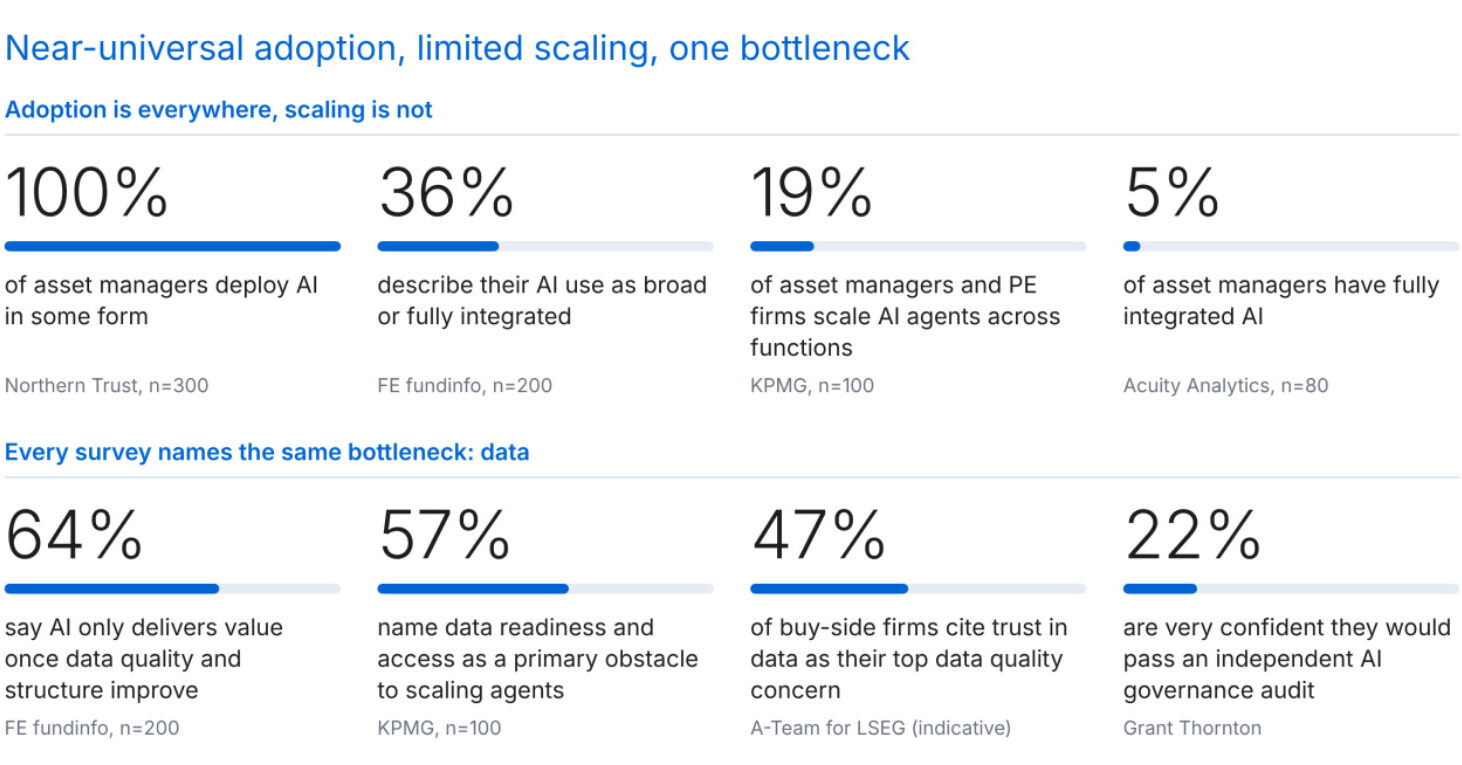
Sources: Northern Trust 1, FE fundinfo 2, KPMG 3, Acuity Analytics 4, A-Team Group for LSEG 5, Grant Thornton 6 (2026 surveys).
These surveys differ in samples and definitions, but they tell one story. Experimentation is everywhere, while deployment at scale, and especially agentic AI, remains the exception. BCG7 notes that the average asset manager still trails banks and fintechs on AI maturity, even as industry leaders pull away.
The models themselves are widely available. What separates firms that scale from firms that stall is the quality, governance and accessibility of the data that feeds those models.
Four questions an AI model cannot answer for you
An AI model is a remarkable reasoning engine. But it can only reason on what it is given. It cannot tell whether a value is wrong, whether two identifiers point to the same company, or whether a figure was actually known on the date it is looking at.
These are not AI model problems. They are data problems, and they must be solved before any model works with the data. They come down to four questions.
1. Data quality: are the values actually right?
A data layer is only as good as what flows into it. Vendor feeds contain gaps, outliers and errors. Left unchecked, those errors reach the AI model as facts, and the model will use them with full confidence.
An AI-ready data layer checks and corrects values on the way in. It does so automatically wherever the rule is clear, and with the help of a human expert wherever it is not.
2. Semantic correctness: does the model know what it is looking at?
Take a simple question: “What is our exposure to this company?” Answering it means linking subsidiaries to their parent company, reconciling multiple identifiers for the same issuer, and looking through fund holdings
It also means knowing exactly which data to use. Every dataset and every field must be properly described: what it measures, in which unit or currency, from which source, at what frequency, and how it relates to other objects. This description, known as metadata, is what tells an AI model which field holds the carbon intensity it needs, or which one gives an issuer’s ultimate parent rather than its direct parent.
Without well-organized reference data and clear metadata, the model has to guess from table and column names. It will produce an answer that sounds plausible, but could be very wrong.
3. Temporal correctness: does the model know what was knowable then?
Data vendors regularly restate figures. Carbon emissions are revised, financial statements are corrected, ratings are updated after the fact.
An AI model working on today’s values uses information nobody had at the time. The backtest looks excellent; the live strategy underperforms. This is look-ahead bias, and AI makes it easier to fall into, not harder.
The remedy is native point-in-time storage enforced in the data layer: every value is stored with the date it became known, so that any past date can be replayed exactly as it was.
4. Governed access: is the model authorized to use this data, and can you prove lineage?
Not all data may be used by an AI model. Vendor licenses often restrict how data can be processed and require it to stay in-house.
Regulators, meanwhile, expect firms to reconstruct the inputs behind any decision. Both requirements demand granular field-level entitlements and lineage, not database-wide controls.
Two more requirements for AI agents
A copilot answers one question at a time, with a human reading every answer. An AI agent works differently. It explores, iterates and chains tasks together. That changes what the data layer must deliver.
Answering at the agent speed, not report speed
To answer a single business question, an agent may run dozens of queries in quick succession: find the universe, pull the exposures, test a hypothesis, refine, test again.
A data platform designed for overnight reports cannot keep up. If each query takes minutes, the agent stalls and costs rise. An AI-ready data layer must answer in well under a second, at a predictable cost.
Keeping confidential data within your own infrastructure
Positions, proprietary signals and in-house models are among an asset manager’s most sensitive information. Sending them to an external AI service is, for many firms, out of the question.
The buy side is clear on this point. Indicative figures from A-Team Group for LSEG show that 70% of buy-side firms prefer hybrid or proprietary AI builds. The driver is not cost but sovereignty: control over data, algorithms and the risk of exposure through third-party infrastructure.
An AI-ready data layer must therefore be deployable in-house, and be able to work with local models where required.
A data layer designed for these requirements from the start
Most data platforms leave clients to meet these six requirements on their own. StarQube took the opposite route. Since 2013, it has designed its platform around the needs of investment teams: governed, point-in-time, research-wide data, ready to feed every step from research to order generation.
Those design choices were made long before generative AI. They turn out to be exactly what AI needs.
Requirement by requirement: what StarQube resolves before any AI model works with the data
| The requirement | How the StarQube platform meets it |
|---|---|
| Ensure the values are right before an AI model sees them | Automated quality checks, resolution rules and exception handling deliver validated data on schedule. And new feeds are integrated in days rather than quarters. |
| Resolve any entity, in any asset class, to a single identity | A proven unified referential, with issuer–instrument hierarchies, multi-identifier mapping and fund look-through, on a data model that extends to any asset class. |
| Only use what was actually known on any past date | Native point-in-time storage, vendor restatements included, so research, backtesting, reporting and AI models all run on as-of data. |
| Control what an AI model can access, and prove lineage | Entitlements per source and per field, with lineage (from raw vendor value to order) traceable on screen, rather than through an overnight report. |
| Answer at the pace of an agent, not of a report | Sub-second queries on a compact proprietary store, so an agent can run an exploratory loop of many queries at predictable cost. |
| Keep confidential data within your own infrastructure | Deployable in the client’s own data center, on premises or in its own cloud tenant, with local models where required. |
More than a semantic layer: built-in investment logic
Many vendors now add a “semantic layer” on top of their data: a dictionary that tells an AI model what each table and column means. It helps, but it stops at definitions.
StarQube goes a step further. Its built-in investment functions encode how investment calculations should be performed: look-through, risk decomposition, ESG aggregation from issuer to instrument.
The result is consistency. An analyst and an AI agent asking the same question are guided to the same, correct calculation. Teams spend less time checking numbers and more time using them.
From AI-ready data to an agent-ready platform
AI-ready data is the foundation. The next step is to let AI work with the whole platform: its data, but also its research, risk and portfolio construction engines. This is where StarQube is investing today.
AI does not replace specialist software, it calls it
Portfolio optimization, backtests and risk models are deterministic: the same inputs must always give the same, auditable result. Large language models are not built that way.
The most advanced practitioners have reached the same conclusion. Research by A-Team Group for LSEG reports a shift away from applying LLMs to everything, toward combining them with purpose-built tools.
StarQube follows this principle. The AI model understands the request and orchestrates the work. StarQube’s proven engines do the calculations, on governed, point-in-time data.
MCP: StarQube, accessible from any LLM
The Model Context Protocol (MCP) is fast becoming the standard way for AI models to connect to data and software. According to A-Team Group for LSEG, more than 70% of buy-side firms plan to use it. BCG notes that data providers are building MCP servers of their own.
StarQube has already taken this step. Two MCP servers are available:
- starqube-doc makes the platform’s documentation available, live, to any AI coding assistant.
- starqube-sqai lets AI agents query StarQube data and drive the platform’s functions.
In practice, a team can use the LLM of its choice to work directly on its StarQube data and analytics, within the entitlements already defined on the platform.
Natural language: faster adoption, higher productivity
StarQube is bringing natural-language interaction into its own web interface. Users can describe what they want in their own language, and the platform does the rest.
The benefits are concrete:
- Faster adoption. Every member of the investment team, from portfolio managers and ESG analysts to risk and reporting teams, can tap into the platform’s full capabilities from day one.
- Better usability. Finding a dataset, viewing it at a given date, setting up a backtest or an optimization becomes a matter of asking, not navigating.
- Higher productivity. A question asked in natural language turns directly into an analysis, freeing time for research and alpha generation.
This matters for the industry as a whole. A-Team Group for LSEG identifies democratized access to AI as the most powerful accelerant of adoption: firms that open AI to the whole organization move faster and keep teams engaged over time.
These capabilities are being rolled out step by step. Agents dedicated to specific workflows across data management, research and portfolio management will follow.
Independence by design
StarQube’s AI strategy rests on a few firm commitments:
- Model-agnostic. Clients can switch AI providers without disruption.
- No training on client data. StarQube uses client data only to serve that client.
- Your infrastructure, your models.The platform runs where the client decides, including with local models.
Where to start: an AI-readiness checklist for investment data
Before launching your next AI initiative, put these six questions to your data layer. Each “no” is a risk that no AI model will fix for you.
- Quality. Are values checked and corrected automatically as they enter the platform, with experts handling the exceptions?
- Identity. Can any security, issuer or fund be resolved to a single identity, with its parent company and look-through holdings?
- Time. Can you replay any past date exactly as the data stood then, vendor restatements included?
- Governance. Can you control which data an AI model may access, field by field, and trace any figure back to its source?
- Speed. Can your platform answer dozens of queries at a reasonable speed and predictable cost?
- Sovereignty. Can your AI work on your data without that data ever leaving your own infrastructure?
If the answer to all six is yes, your data is ready for AI. If not, that is where your AI strategy should begin.
FAQ
What is AI-ready investment data?
AI-ready investment data is data an AI model can use safely and correctly without further human cleanup. It is quality-checked, mapped to a single identity per entity, stored point-in-time, and governed by field-level entitlements and lineage. For AI agents, it must also be fast to query and, when confidential, kept in-house.
Why do AI pilots fail to scale in asset management?
Most pilots stall when they meet real-world data. Information from different teams uses inconsistent identifiers, timestamps and granularities, so models cannot combine it reliably. Industry surveys from KPMG, FE fundinfo and Northern Trust all point to data readiness, not model capability, as the main obstacle.
Why does point-in-time data matter for AI?
Data vendors frequently restate past figures. An investment model trained or tested on today’s restated values uses information that was not available at the time, which inflates backtest results. Point-in-time data records when each value became known, so research, backtests and AI models see only what was knowable on any given date.
What is a semantic layer for investment data?
A semantic layer describes what each dataset and field means, so that an AI model can interpret data correctly instead of guessing from table names. In investment management, it should go further and encode business rules: how to compute an exposure, apply fund look-through, or aggregate ESG data from issuer to instrument.
What is MCP and why does it matter for asset managers?
The Model Context Protocol (MCP) is an open standard that lets AI models connect to external data and software. For asset managers, it means a chosen LLM can query investment data and use specialist tools directly, without custom integrations. More than 70% of buy-side firms plan to use MCP, according to A-Team Group for LSEG.
Can AI agents for portfolio management run on premise with confidential data?
Yes, provided the data platform and the models can be deployed inside the firm’s infrastructure. StarQube can run in a client’s own data center or cloud tenant and work with local models, so positions, signals and proprietary models remain in-house.
Ready to put AI to work on your investment data?
AI will reward the asset managers whose data is ready for it. StarQube has spent more than a decade
building that foundation, and is now opening it to the AI models and agents of your choice.
Request a demo to see how StarQube can make your investment data AI-ready.
1 Northern Trust – “Driving Growth in Asset Management 2026”, press release, September, 15 2026 – https://www.northerntrust.com/united-states/pr/2026/northern-trust-survey-asset-managers-sharpen-focus-on-core-capabilities-to-drive-growth
2 FE fundinfo – “2026 Asset Managers Report”, reported by Funds Europe, June 24, 2026 – https://funds-europe.com/fragmented-data-remains-an-obstacle-as-industry-invests-to-close-the-gap-survey-finds/
3 KPMG – “AI Quarterly Pulse: Asset Management and Private Equity Q2 2026”, reported by InvestmentNews – https://www.investmentnews.com/transformation/ai-spending-in-asset-management-tops-100m-as-agent-adoption-stalls/267192
4 Acuity Analytics – “Annual Survey of Asset Managers 2026”, reported by FinTech Global, July 30, 2026 – https://fintech.global/2026/07/30/nearly-a-fifth-of-asset-managers-yet-to-use-ai-with-full-integration-confined-to-the-largest-firms/
5 A-Team Group for LSEG – “Generative and Agentic AI in Financial Markets: From Pilot to Platform”, September 2026 (survey of 200 buy-side and sell-side decision-makers in the USA, UK and Canada, June 2026; figures quoted as indicative).
6 Grant Thornton – “Asset Management: 2026 AI Impact Survey” – https://grantthornton.com/insights/survey-reports/asset-management/2026/asset-management-2026-ai-impact-survey
7 BCG – “AI-First Companies Win the Future: Asset Management”, July 2026 – https://web-assets.bcg.com/0a/ee/205f2e4f4265ae746ce204323a1f/executive-perspectives-ai-first-companies-asset-management-2.pdf
